











Emmy Farrow left Cranberry Cove at eighteen and never planned to come back. Fourteen years and one burned-out hospitality career later, a phone call brings her home to the little Maine harbor town she grew up in: her grandmother has taken a fall, and the rambling old inn Nan has poured forty years of her life into is falling down around her.
The plan is simple. Get the Cranberry Inn patched up and profitable, or get it sold, and be back in Boston by fall with her tidy, portable, carefully rootless life intact.
The plan does not survive contact with Ben Tolliver.
Ben builds boats, keeps to himself, and has exactly zero patience for a woman who already has one foot out the door. He agreed to fix the inn's roof as a favor to Nan, not to spend his summer arguing with her sharp-tongued granddaughter over spreadsheets and shingles. He's a widower with an eight-year-old daughter and a heart he closed for repairs four years ago, and he is not looking to open it for someone who's leaving.
But the roof needs more than money can fix, a slick out-of-town developer is circling the whole waterfront, and Ben's daughter Pip, who reads the tide pools like scripture and doesn't warm to just anyone, has decided Emmy is worth keeping. Between paint fumes and low tide and a town that stubbornly refuses to let her stay a stranger, Emmy finds herself falling for exactly the life she spent fourteen years running from.
When the job she always wanted finally calls, Emmy has to decide what home actually is, and whether the bravest thing a person can do is stop running and stay.
The Inn at Cranberry Cove is the first book in Cranberry Cove, a warm, small-town coastal romance series full of found family, second chances, and a town worth fighting for. Grumpy-sunshine slow burn, a swoony single dad, a scene-stealing kid, and a happily-ever-after you'll want to move to Maine for. Closed-door / behind-the-door heat, book-club clean.
eBook epub
Rosie Quinn has a rule, and she has never once broken it: no cameras, no questions, no name from before. Two winters ago she arrived in Cranberry Cove with good knives and no history, and the inn's back kitchen became the one room where she was only her hands, laminating dough at five in the morning while the town quietly agreed not to ask what she left behind.
Theo Croft sees people for a living. He reads a room through a lens before he ever says hello, and he has spent his whole career pointing a camera at exactly the thing everyone else is too polite to look at straight on. Wintering over in the inn's room seven was only ever supposed to be about the light on the harbor. Then he meets the one woman in town who turns her face from every frame, and for the first time in his career, he wants to put the camera down.
A decommissioned lighthouse across the water becomes the reason they cannot stay strangers: a boarded-up keeper's cottage the town decides to restore, a tea room Rosie could run in her own name, a lantern room that has not thrown a beam since 1991. Theo promises her, plainly and more than once, that he will never point a lens at her. He means it completely, right up until an old photograph he thought he had killed runs anyway, under her face, under her name, in front of the one kind of stranger she has spent two years making sure never finds her again.
To Rosie, the man who promised looks exactly like the man who broke his word. The mistake belongs to someone else entirely, but the fear it wakes up is older than Theo and has nothing to do with him. Rosie has one skill that has never failed her: disappearing. She is good at it. She has done it before.
This time, the only way through is to stop running before she starts, climb to the top of a lighthouse she has always loved from a safe distance, and choose, on her own terms and in front of the whole town, to be seen.
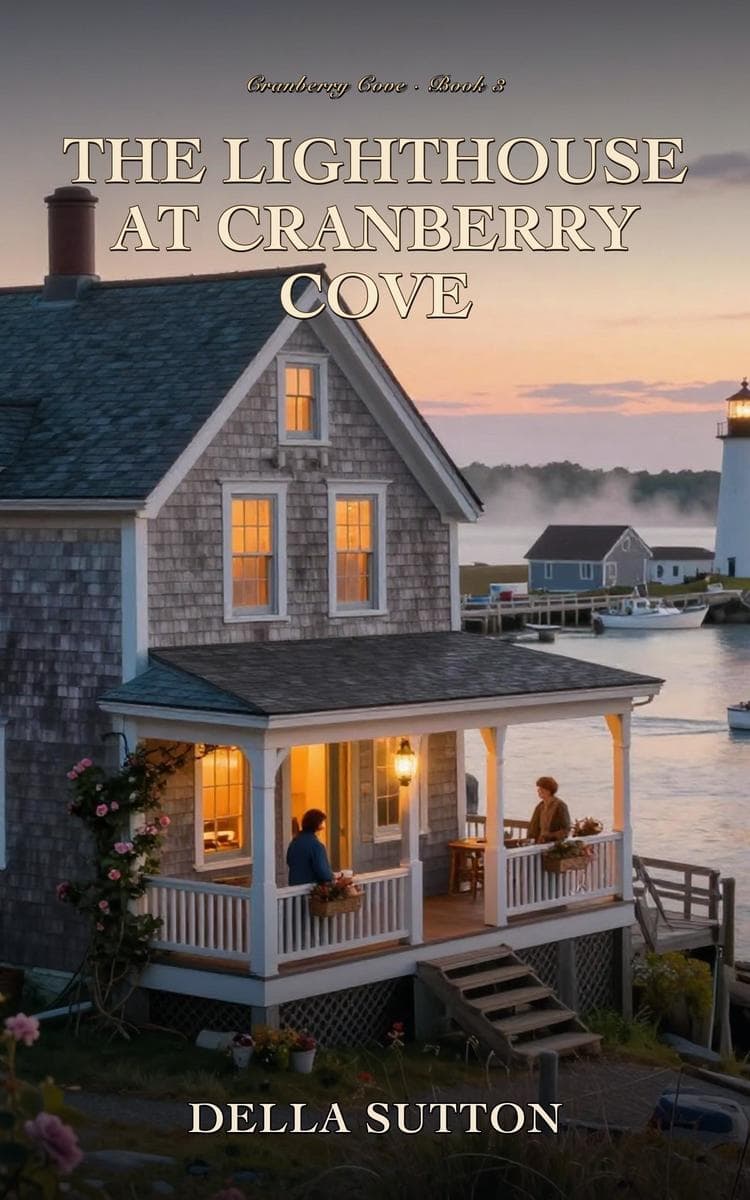
The Lighthouse at Cranberry Cove is the third book in the Cranberry Cove series: a newcomer-and-hidden-past slow burn about a woman who spent years disappearing and the photographer who falls for her without ever raising the camera. Warm found family, a restoration project that becomes a self-claim, and a happily-ever-after under a working light. Come home to the cove.